Facebook Marketplace
Post inventory to Marketplace from your own browser, paced and capped per account so volume never looks automated. Buyer messages come back into DealerHQ.
Appraise a trade against live retail comps, stock it, run the deal — price ladder, financing, tax by province, the bill of sale — track the customer and the delivery after, keep it OMVIC compliant, and put it in front of buyers on your own site and on AutoTrader, eDealer and CarGurus. One login, one vehicle record, nothing re-typed into a second system because the first one doesn't talk to it.
Running on live dealership floors in Ontario today.
Most stores run an appraisal tool, a DMS, a CRM and a delivery tracker that do not speak to each other. A trade appraised here becomes the unit on the lot, the deal that gets desked, the customer record that gets kept, and the delivery that gets run — without being typed in again anywhere.
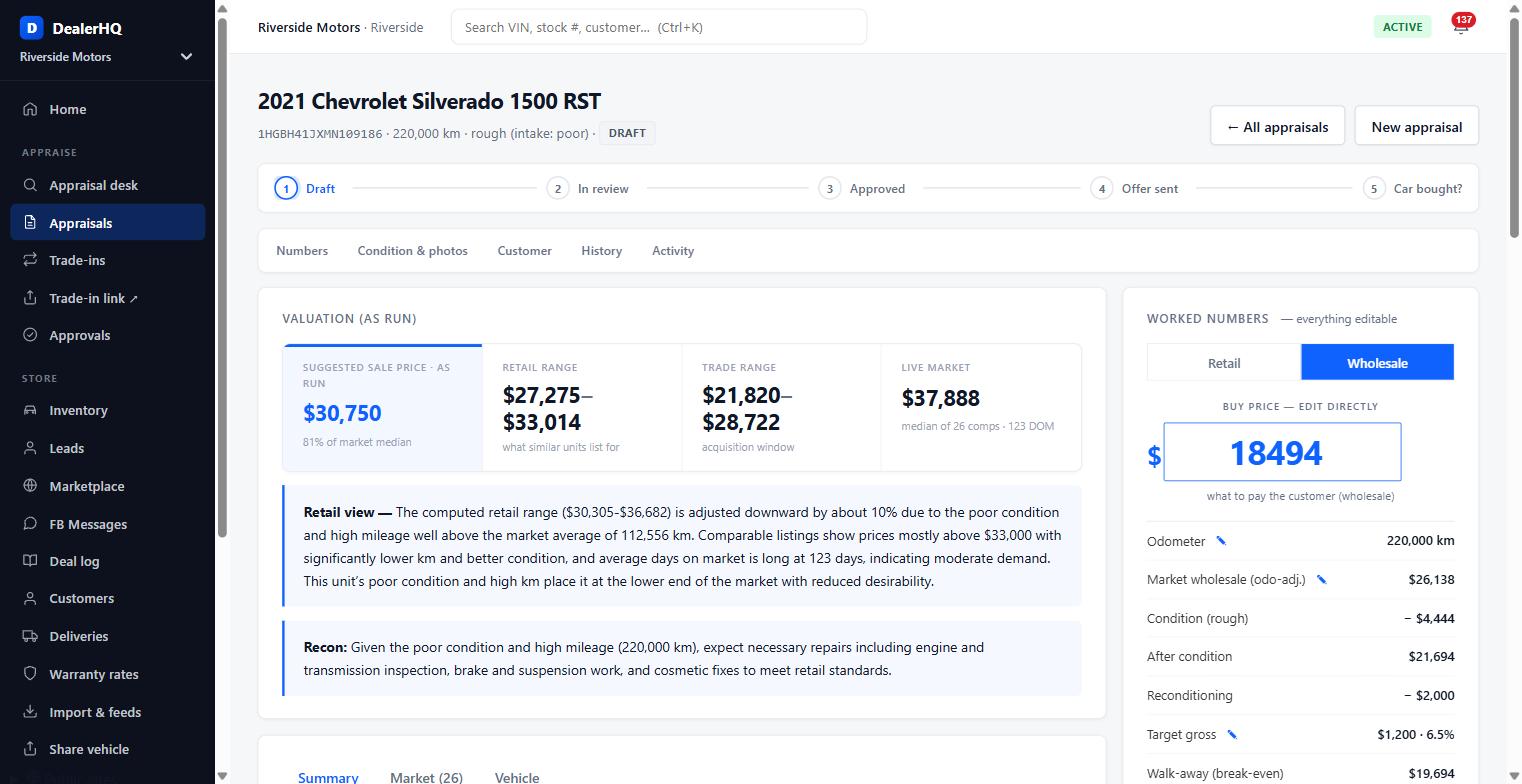
Scan the VIN. DealerHQ pulls comparable retail listings, reconciles them against book value, and shows the working — condition, reconditioning, target gross, and the walk-away price under which the deal stops making money.
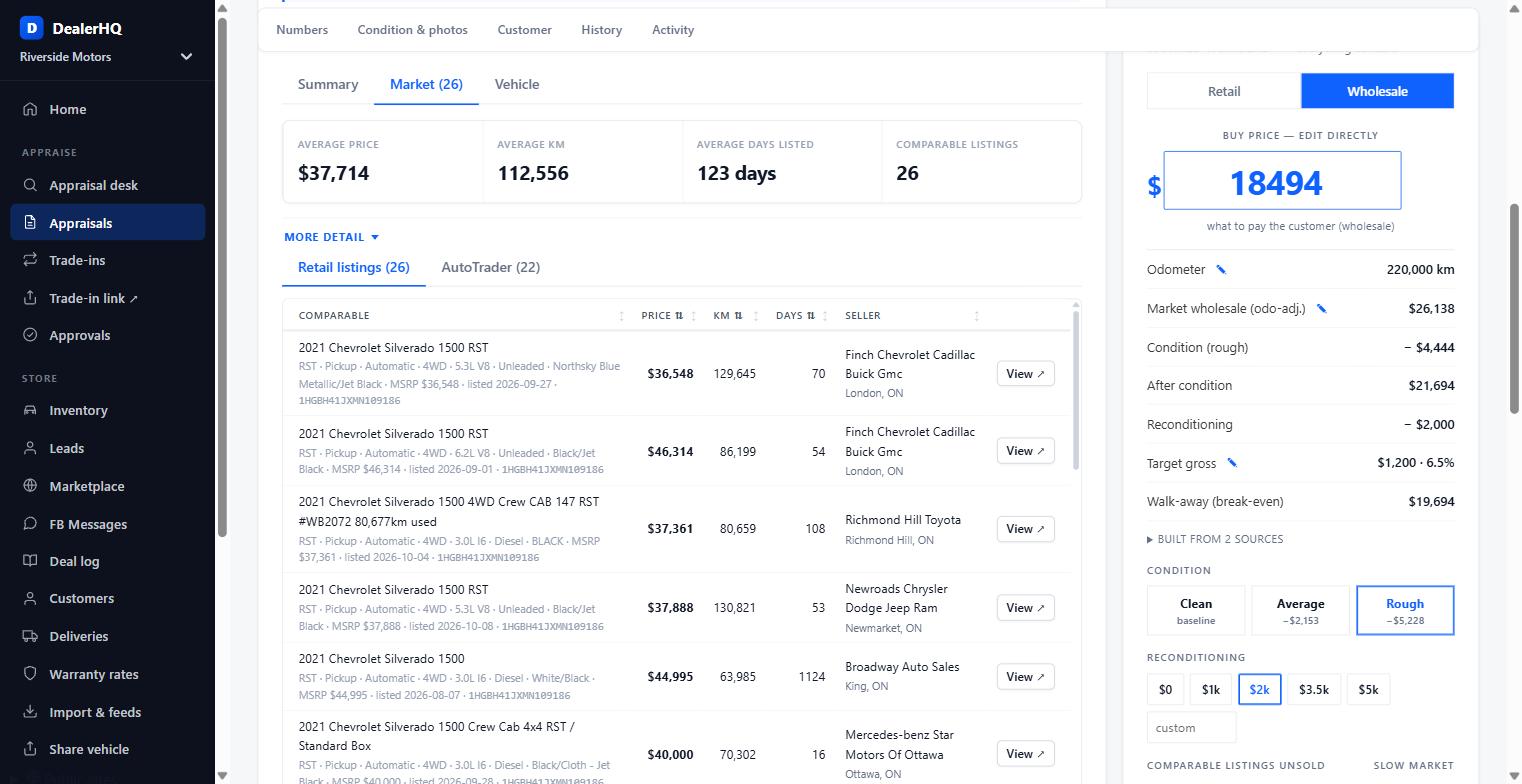
Every appraisal carries the listings it was built from — what each competing store is asking, how far they have driven, and how long it has been sitting. A slow market and a fast one are not the same buy, and the page says which one you are in.
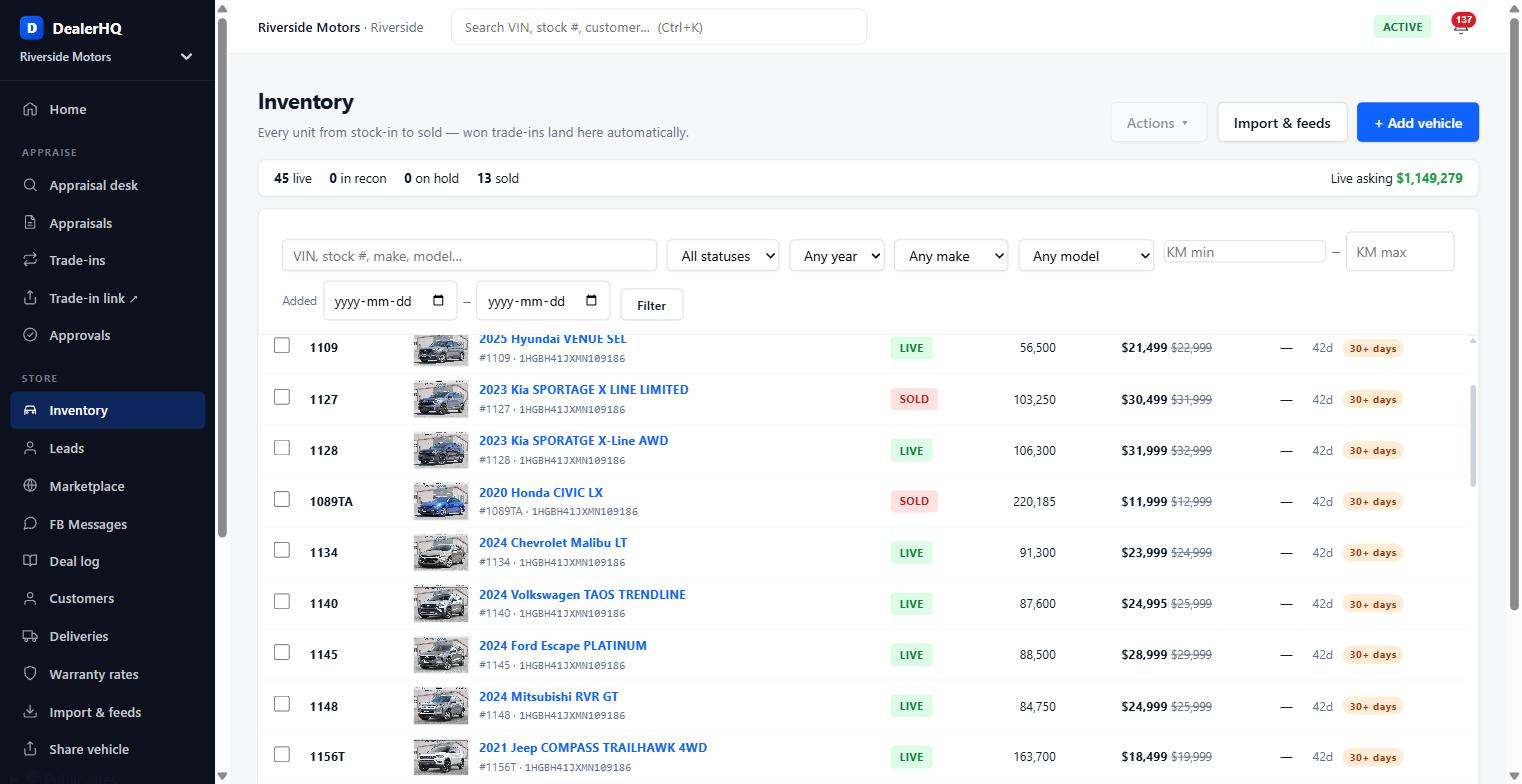
Won trade-ins land in inventory automatically. Aging is visible before it is expensive, your public site stays in step, and when a buyer's ready the deal desk runs the whole sale — price ladder, trade allowance, financing, tax by province, the bill of sale — with OMVIC disclosure confirmed per unit, not assumed. The customer and the delivery stay attached to the same record after the ink is dry.
Built from what dealers kept asking for, in the order they asked.
Post inventory to Marketplace from your own browser, paced and capped per account so volume never looks automated. Buyer messages come back into DealerHQ.
Your live inventory pushed out automatically every night — no exports, no spreadsheets, no manual re-listing when a price or a photo changes. CarGurus picks up the same listings through eDealer's feed.
A link or widget on your site that lets a customer value their own car. The appraisal lands on your desk with photos already attached.
Buyers work inside a limit. Anything past it routes to a manager with the numbers and the reasoning, and the decision is logged.
Website forms, ADF email, webhooks and your showroom pages feed one board, with the attribution carried through.
A live inventory site on your own domain, fed by the same stock list, with lead forms and compare built in.
Gross by unit, days to turn, where leads come from and which buyer calls the market right — per store, per person.
Price ladder, trade allowance, warranty and GAP, lender terms, tax by province — the whole deal built on one screen, with front and back gross visible as it moves. Retail bill of sale, the UCDA-format wholesale bill of sale and the dealer's wholesale buyer agreement all print from the same numbers, not a re-typed copy of them.
A real record per buyer, not just a line on a deal — contact info, every vehicle they've bought, and whether the review request actually got answered.
As-is, unfit, prior rental or police use, branded title — confirmed per unit, never defaulted to a denial. A car nobody has checked yet reads as unknown on the lot and stays off the as-is statement that only prints when the condition actually applies. The badge on the listing image and the full disclosure on the vehicle page come from the same flag — set it once.
A button that reads your live inventory against OMVIC's own published advertising rules — flags what it can actually verify (a finance price higher than cash, a sale price that doesn't undercut asking, a missing OMVIC number), names the exact unit and what to fix, and confirms what's already structurally correct. What it can't mechanically check — as-is wording, certification-fee disclosure, material facts — it lists honestly with a link to OMVIC's guidance, rather than faking a pass.
HST, GST+QST, GST+PST — the right combination for where you sell, computed automatically on every deal alongside your own standing fees. Nothing added at the desk that wasn't in the price shown.
Attach a report link to a unit and it shows on the listing automatically — detail page and the lot grid both, with the official CARFAX badge, not a logo we drew ourselves.
A run sheet per sold unit — safetied, MTO paperwork, detailed, picked up. A deal reads ready for delivery automatically once the required items are ticked, not because someone remembered to update a status.
Every car created, deleted or moved between statuses is logged with who did it and the time. Kept seven years, same floor as the deal and customer records it sits beside.
One group, several stores, each with its own inventory and its own public site — rolled up for whoever is watching the whole group's numbers.
Open campaigns from Transport Canada's recalls database and NHTSA, on every appraisal. Canada-only campaigns that US-fed tools miss are caught. The summary is written from those records and nothing else — it never invents a fault.
Decode a VIN, search the live market, or look up a model's known problems without opening an appraisal or spending one.
Bring a VIN you appraised last week. We will run it through DealerHQ and you can judge the number against what you actually paid. No obligation, no card.